


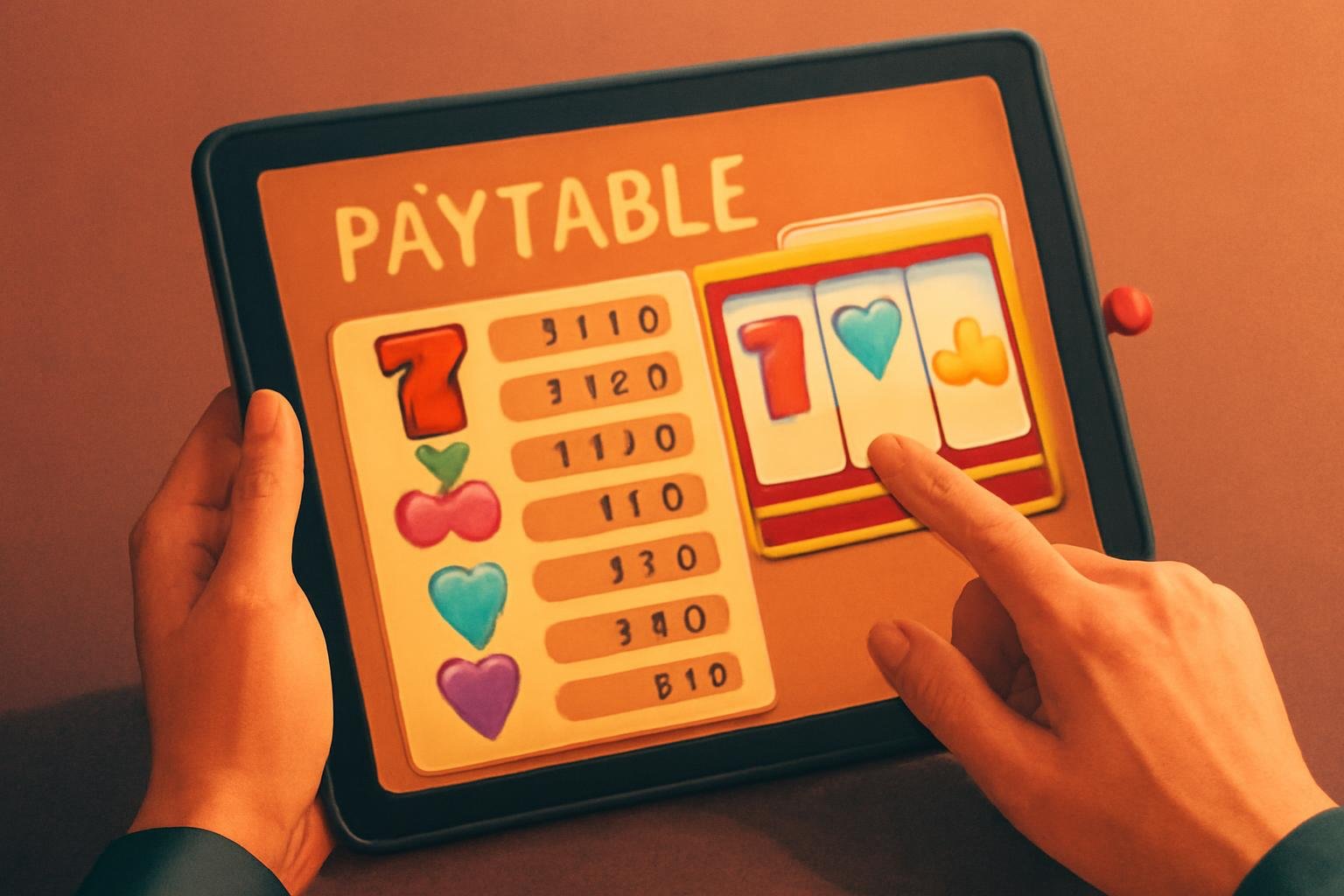
A slot’s paytable is more than a list of symbols and payouts. It explains how the game works, which features affect a round, and what the displayed numbers do—and do not—tell you. Taking a few minutes to read it can help you compare games and avoid surprises, without treating any setting as a way to predict a win.
If you are exploring different kinds of online slots, start with the game’s own information screen rather than relying on its theme or animations. Details vary by game, so check the rules for the specific slot you are considering.
Find the paytable and rules
Look for a button or menu labelled “Paytable,” “Help,” “Info,” or “Rules.” Some games split information across several screens. Read through them before starting, and check whether the game lets you view the rules without placing a wager.
Pay attention to the symbols used in examples. A game may show several symbol combinations, but the payout can depend on how many matching symbols appear, where they land, and whether they form a valid line or pattern. The paytable should explain those conditions.
Check how winning combinations are counted
Do not assume every slot counts wins in the same way. A game may use fixed paylines, ways to win, or another system described in its rules. If paylines are involved, find out whether they must be selected or whether all available lines are active at the chosen bet. Also check the direction in which a combination must appear.
For a “ways to win” format, read how adjacent reels and matching symbols are evaluated. The presentation can look different from a traditional payline game, but the rules still determine which symbol groups qualify. Understanding this distinction makes it easier to interpret the game’s examples and displayed wins.
Understand the payout table’s limits
A listed payout describes a result under stated conditions; it is not a promise that the combination will occur. Confirm whether values are shown per coin, per line, or for the total wager. If the game offers a selectable bet, check whether changing it affects the payout, the number of active lines, or access to particular features.
Look for details about wild and scatter symbols, free spins, multipliers, and bonus rounds. The rules may specify where a symbol needs to land, what triggers a feature, whether a feature can retrigger, or how a bonus prize is calculated. These details are game-specific, so avoid relying on assumptions carried over from another slot.
Read RTP and volatility carefully
If a return-to-player (RTP) figure is provided, treat it as a theoretical percentage calculated over a very large number of plays, not a forecast for an individual session. It does not indicate when a payout will happen or how much a particular player will receive. Check whether the game displays more than one RTP setting and which setting applies to the version being offered.
Volatility, sometimes called variance, describes the general pattern of payouts: some games tend toward more frequent smaller results, while others may have less frequent but larger potential results. It does not make a session predictable, and it cannot remove the chance of losing a wager. For a broader look at how formats differ, see this overview of online slot features.
A quick pre-play checklist
- Can you locate the full rules and paytable?
- Do you understand how the game counts winning combinations?
- Have you checked what the bet amount includes?
- Are bonus features and special symbols explained clearly?
- Do you understand that RTP and volatility do not predict your results?
- Can you set a spending limit before starting and stop when you reach it?
If a feature is confusing, pause instead of guessing. Some games include layered bonus mechanics or interactive elements; the rules screen is a more reliable guide than the animation alone. You can also compare how different formats present their features in this article about video and 3D slots.
Make the information useful
Reading a paytable helps you understand the rules, not improve the odds or guarantee a result. Choose only games and stakes that fit an entertainment budget, and do not chase losses or borrow to play. If gambling stops feeling enjoyable or becomes difficult to control, take a break and seek support from a suitable local service.
The practical takeaway is simple: check the combination rules, wager structure, special features, and any stated RTP before you begin. If you cannot explain how the game works after reading its information, choose another game—or do not play.

